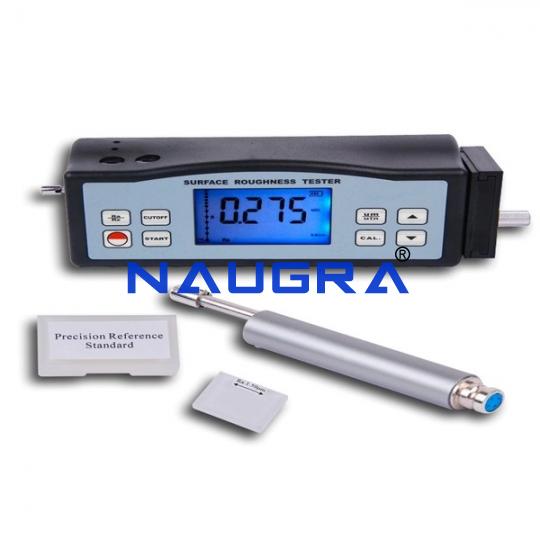
About this TVET Equipment
TVET Surface Roughness Testers is suitable for Vocational Lab, Industrial Training Institutions, TVET Engineering Colleges and Polytechnics — suitable for Civil and Mechanical Engineering Lab tender supply.
This TVET Surface Roughness Testers is part of our TVET Engineering Lab Equipment tender catalogue covering Workshop Machines & Accessories, CAD/CAM Lab, Measurement Lab, Refrigeration & Air Conditioning Lab, Materials Testing Lab, Applied Mechanics Lab, Fluid Mechanics Lab, Turbo Machinery Lab, Heat & Mass Transfer Lab, Thermal Engineering Lab, Automobile Engineering Lab, Concrete Testing Lab, Cement Testing Lab, Soil Testing Lab, Bitumen Asphalt Testing Lab, Aggregate Testing Lab, Steel Testing Lab, Structural Engineering Lab, Environmental Testing Lab and Surveying Lab Equipment.
TVET Surface Roughness Testers
Description & Specification
Roughness is an important parameter when trying to find out whether a surface is suitable for a certain purpose.
Rough surfaces often wear out more quickly than smoother surfaces.
Rougher surfaces are normally more vulnerable to corrosion and cracks, but they can also aid in adhesion.
A roughness tester is used to quickly and accurately determine the surface texture or surface roughness of a material.
A roughness tester shows the measured roughness depth (Rz) as well as
the mean roughness value (Ra) in micrometers or microns (µm).
Measuring the roughness of a surface involves applying a roughness filter.
Different international standards and surface texture or surface finish
specifications recommend the use of different roughness filters.
When measuring the roughness of a surface, the sensor is placed on the
surface and then uniformly slides along the surface by driving the
mechanism by the sharp built-in probe.
This roughness causes displacement of the probe, which results in change
of inductive amount of induction coils so as to generate analogue
signal, which is in proportion to the surface roughness at output end of
phase-sensitive rectifier.
The exclusive DSP processes and calculates and then outputs the measurement results on LCD.
FEATURES:
Four wave filtering methods: RC, PC-RC, GAUSS and D-P.
Built-in lithium ion rechargeable battery and control circuit with high capacity.
Multiple parameter measurement: Ra, Rz, Rq, Rt.
Highly sophisticated inductance sensor.
Small in size, light in weight and easy to use.
SPECIFICATION:
Display: 4 digits, 10 mm LCD, with blue backlight
Parameters: Ra, Rz, Rq, Rt
Measuring Range :
Ra, Rq: 0.005-16.00um/0.020-629.9uinch
Rz, Rt: 0.020-160.0um/0.780-6299uinch
Accuracy: ≤ ± 10%
Test Principle: Inductance type
Radius of Probe Pin: 5 um
Material of Probe Pin: Diamond
Resolution :
0.001 um, if reading < 10um
0.01 um, if 10um ≤ reading ≤ 100um
0.1 um, if reading ≥ 100um
Quick TVET Tender Quote
Need this for a tender? Get a detailed BOQ quotation in 24 hours.